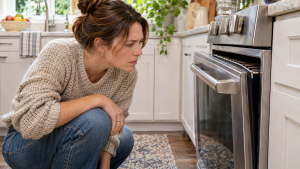
A Door Gap Changes More Than Baking Results
An oven door needs a clear path and properly aligned hinges to seal against the frame. Something simple, such as a rack not fully seated or a casserole handle touching the glass, can make the last inch of travel impossible. Whirlpool advises checking whether a rack or oversized bakeware is keeping the door open. That observation should happen only after the cavity cools; a hot rack can burn long before it looks dangerous.
A lock mechanism creates a different obstruction. On self-clean models, a latch arm may be extended or out of alignment. Whirlpool’s latch guidance tells owners to look at the arm above the gasket; it does not invite them to bend it back. A door that looks lower on one side, drops too far, or springs away from the frame may have hinge or spring damage. Those parts carry force and are not good trial-and-error adjustments for a homeowner.
A gap can let heat escape toward controls and nearby cabinetry, and it can interfere with cooking. Do not keep baking because the oven still heats. If the cavity continues heating after Off, follow the oven-will-not-turn-off guide. A door that seals but gives uneven cooking belongs in the temperature guide. The closure problem itself should be addressed before either test.
For model-specific service after these checks, see Oven repair, Oven won’t turn off.
Reading the Clues
Take a photo from the side rather than pushing on the door to find where it contacts. A gap near the top center may be a latch or rack clue; a wider gap at one corner is more suggestive of hinge or alignment trouble. Check whether a gasket has simply lifted out of its usual channel, but do not peel it away or stretch it. If someone recently removed the oven door for cleaning, mention that to a technician. Reinstallation instructions vary, and an improperly seated hinge can release unexpectedly. Built-in wall ovens should stay in the cabinet during homeowner inspection; pulling one out is a two-person, power-isolation job for service professionals. A door that closes normally but an oven that will not heat points to another path. An oven fan that keeps running after Off also needs its own timing and cooling checks, not hinge work.
Step-by-Step Troubleshooting
1. Turn off and cool the oven
Wait until the racks, frame, and glass are cool. Do not test closure during self-clean or while the lock indicator is active.
2. Check for smoke or active heat
If the oven keeps heating after Off, treat that as a separate stop-use fault. Do not rely on an open door to dissipate heat.
3. Remove oversized cookware
A roasting pan, lid, or handle can touch the door. Once cool, move it to a correctly sized position and close gently.
4. Reseat the racks
Check that each rack sits level on its guides and has the correct front-to-back orientation for the model. Do not force a sliding or telescoping rack.
5. Look for a displaced gasket
Inspect the cool door seal for an obvious fold, detached section, or debris. Clean gently as the manual allows; do not pull out the seal to make it fit.
6. Check the latch visually
If a latch arm protrudes into the door path, photograph it. Whirlpool says latch position can prevent closure. Do not pry or bend the mechanism.
7. Compare the door gaps
From the front and side, note whether the gap is even. An uneven or drooping door can indicate hinge or mounting trouble.
8. Close gently once
After correcting a clear rack or pan obstruction, close with normal pressure. If resistance remains, stop; repeated force can break glass, hinges, or the latch.
9. Avoid removing the door
Oven doors are heavy and hinge arms can snap into position. Leave removal, reinstallation, and spring adjustment to qualified service unless the manual explicitly provides a safe homeowner procedure.
10. Schedule repair for persistent misalignment
Report whether the door springs open, sags, rubs at one edge, or shows a lock message. A technician can check hinges, latch, gasket, and frame without damaging the door.
Brand-Specific Considerations
Whirlpool and KitchenAid: Whirlpool documents rack and cookware interference as well as a latch arm that may block closure. Use the exact model manual for rack placement and lock behavior. Brand-specific service is covered by Whirlpool appliance repair.
GE and Café: Door-hinge and self-clean designs vary. Note whether the problem began after a door was removed or after a cleaning cycle.
Bosch and Thermador: Wall-oven doors can be heavy and sit close to cabinetry. Do not pull a built-in appliance forward to investigate a small gap.
Wolf and Viking: Premium ovens may use substantial hinges and layered doors. A sagging or loose door merits model-specific service rather than a generic hinge trick.
Repair vs. Replace Guidance
A rack or cookware obstruction needs no part. A gasket, latch, or hinge may be repairable on an otherwise sound oven. Ask a technician whether the frame, door, and locking mechanism are intact before ordering a hinge alone. Replacement is more reasonable for an older oven with a damaged chassis or door assembly, unavailable parts, and other expensive faults. A gap that sends heat toward cabinetry is a stop-use issue even if the oven is relatively new.
Cost Expectations
Reseating an oven rack or removing an obstruction takes no replacement part. A bent hinge, damaged door gasket, latch, or frame changes the repair price and may require more labor on a built-in oven. The quote should identify which component prevents a proper seal; buying a pair of hinges without diagnosis can miss a warped door or mispositioned rack. An oven that cannot close safely should not be used while waiting for an estimate. Compare the repair with replacement only after the model, age, parts availability, and other heating or control issues are known.
Why Choose Universal Appliance Repair
Universal Appliance Repair can check the door geometry and latch after the oven cools and the accessible rack and bakeware checks are complete. Tell the technician whether the door is uneven, springs open, or stops against a particular rack position. If cooking results are also inconsistent, mention the oven temperature guide because a leaking door seal can affect cooking. Use the oven repair service for hinge or latch work.
Appliance Lifespan Table
Refrigerator: 10-15 years. Maintenance priority: clean coils, protect door seals, and keep temperatures steady.
Freezer: 10-20 years. Maintenance priority: keep vents clear, check gasket contact, and defrost models that require manual defrosting.
Dishwasher: 8-12 years. Maintenance priority: clean the filter, inspect spray arms, and avoid blocked drain paths.
Washing machine: 8-12 years. Maintenance priority: avoid overloading, use the right detergent amount, and inspect hoses.
Dryer: 10-13 years. Maintenance priority: clean the lint filter, vent path, and exterior termination.
Range or oven: 10-15 years. Maintenance priority: keep burners, igniters, caps, racks, and controls clean.
Maintenance Checklist
- Slide racks fully onto their guides after cleaning.
- Keep oversized bakeware clear of the door path.
- Wipe gasket contact areas only as the manual allows.
- Close the oven gently rather than slamming it.
- Report a new uneven gap before running self-clean.
Safety Section
Do not force, pry, or bend an oven door latch. Let the oven cool fully before touching racks or the gasket. Do not run an oven whose door cannot close and seal, whose glass is loose, or whose lock behaves unpredictably. Never remove a heavy door alone, bypass an interlock, or use self-clean to try to reset a latch. If gas odor appears, leave the area and follow utility emergency guidance without operating switches.
What to Tell the Technician
Provide the model number, whether the oven is wall-mounted or a range, where the gap appears, when it began, whether racks or cookware were changed, and whether a self-clean cycle or door removal preceded it. Send photos of the gap and latch without touching the mechanism.
Key Takeaways
- Cool the oven before checking door closure.
- Racks and cookware are the first safe obstructions to rule out.
- A latch or uneven hinge is not a force-it-shut problem.
- Do not use an oven that cannot close and seal properly.
Homeowner Actionability Score
24/25. The reader can locate simple obstructions and identify a hazardous latch or hinge pattern without disassembling a heavy, hot door.
Editorial Standard
This article was checked against manufacturer guidance and the Universal Appliance Repair Knowledge Base v6.0 for safe homeowner actions, clear stop points, and source accuracy.
Sources and Further Reading
Author Information
The Universal Appliance Repair Certified Expert Team consists of experienced appliance repair professionals with more than 25 years of combined hands-on experience servicing residential appliances. Articles are reviewed using manufacturer guidance, current industry best practices, and practical field experience.