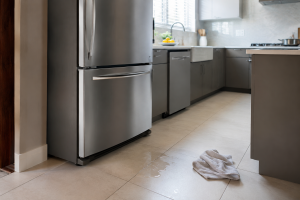
Why Refrigerator Leaks Need Quick Attention
A refrigerator leak is easy to underestimate because the appliance may still cool normally. The food feels cold, the freezer works, and the puddle looks small. But even a slow drip can damage flooring, swell cabinet panels, create odors, encourage mold, or reach electrical parts.
The good news is that the location of the water usually tells you where to start. Water inside the fresh-food section points in a different direction than water behind the refrigerator. A puddle under the freezer may suggest a defrost drain issue. A drip at the dispenser may be related to a filter change or air in the water system. Water near the back may mean a supply line, fitting, valve, or filter connection needs attention.
This guide walks through safe homeowner checks before you schedule refrigerator repair. The goal is not to turn a homeowner into a technician. It is to help you protect the floor, narrow the source, and know when the problem has moved beyond safe DIY.
How Refrigerator Water Is Supposed to Move
Most modern refrigerators manage water in several ways. During normal operation, frost forms on the evaporator coil and then melts during the automatic defrost cycle. That water should flow through a defrost drain and into a drain pan, where it evaporates. Models with water dispensers and ice makers also use a water supply line, inlet valve, filter, internal tubing, reservoir, fill tube, and dispenser parts.
When everything works, you should not see water pooling inside the refrigerator or on the floor. Leaks happen when water cannot follow its intended path or when pressurized water escapes from a connection.
Common leak paths include:
- Defrost water blocked by ice, food debris, or a clogged drain tube.
- Water line not fully seated at a fitting.
- Cracked, kinked, or loose supply tubing.
- Filter installed incorrectly or not compatible with the model.
- Air trapped in the water system after a filter change.
- Ice maker fill tube misalignment or valve seepage.
- Door gasket allowing warm, humid air to enter.
- Refrigerator tilted in a way that sends water forward instead of toward the drain pan.
- Drain pan cracked, shifted, or overflowing because another problem is adding too much water.
Manufacturer guidance from Whirlpool, LG, GE Appliances, and Samsung commonly points homeowners toward drain blockage, water filter seating, water line fittings, dispenser flushing, ice maker conditions, and leveling when refrigerators leak.
Step-by-Step Troubleshooting
1. Protect the Floor and Track the Leak Pattern
Start by drying the area completely. Place towels where the water appears and take a photo of the puddle location before cleaning it. The pattern matters. Water at the front left, front right, inside a drawer, behind the refrigerator, or under the freezer can each point to a different source.
Safe homeowner action: Dry the floor and inside compartments. Check again after several hours and again the next day.
Call for service if: Water returns repeatedly, spreads under flooring, or appears near electrical outlets.
2. Rule Out Food Spills and Open Containers
Not every puddle inside a refrigerator is a mechanical leak. Open food containers, loose bottles, watermelon, thawing food, and uncovered liquids can spill or release moisture. Hot food placed directly into the refrigerator can also create condensation.
Safe homeowner action: Remove items from the wet area, wipe shelves and drawers, and check containers. Cool hot food before storing it, and use sealed containers when possible.
Call for service if: Water returns after the compartment is clean and dry.
3. Check Door Closure and Gaskets
Warm kitchen air contains moisture. If the refrigerator door does not seal fully, that moisture can condense or freeze inside the appliance. Later, it may melt and look like a leak.
Look for food packages blocking the door, drawers not pushed in, damaged gaskets, sticky gasket surfaces, or a door that swings open because the cabinet is not level.
Safe homeowner action: Clean gaskets with mild soap and warm water, remove obstructions, and confirm the door closes without resistance.
Call for service if: The gasket is torn, warped, loose, or the door does not align correctly.
4. Look for Water Under the Crisper Drawers
Water under crisper drawers often points to a clogged or frozen defrost drain, especially if the water returns after you wipe it up. Defrost water should drain away; when it cannot, it may collect under drawers or run onto the floor.
Some models make the drain opening visible. Other models hide it behind panels. Do not remove panels unless your owner manual gives clear instructions.
Safe homeowner action: Remove food and drawers, wipe water, and look for ice buildup or recurring puddles.
Call for service if: Water returns, you see ice under drawers, or the drain is behind an interior panel.
5. Check for Ice on the Freezer Floor
Ice on the freezer floor plus water leaking onto the kitchen floor is a classic defrost-drain clue. During defrost, water may run across the freezer floor, freeze into a sheet, then overflow out the door or under the cabinet.
Safe homeowner action: Move food to protect it, photograph the ice pattern, and avoid chipping ice with sharp tools.
Do not do this: Do not use knives, screwdrivers, heat guns, or open flame to remove ice. These can puncture the liner, damage refrigerant tubing, or create injury risk.
6. Inspect the Water Filter Area
If your refrigerator has a water dispenser or ice maker, the filter area is a common leak point. A filter may be installed crooked, not fully locked, incompatible with the model, missing an O-ring, or damaged. A cracked filter housing needs repair.
Safe homeowner action: Follow the owner manual to remove and reinstall the filter. Use the correct model-specific filter. Wipe the area dry and check for new drips.
Call for service if: The filter housing is cracked, water drips with the correct filter installed, or the filter will not lock securely.
7. Flush the Dispenser After Filter Changes
After a filter replacement or new refrigerator installation, air can remain in the water system. That trapped air can cause spurting, cloudy water, slow flow, or dispenser drips that look like a leak.
Safe homeowner action: Flush the dispenser according to the owner manual. Many manufacturers recommend dispensing several gallons after a new filter, but the exact amount can vary by model.
Call for service if: Water keeps dripping long after flushing, the dispenser paddle sticks, or water dispenses on its own.
8. Check the Ice Maker and Ice Bin
Ice maker leaks may show up as water in the ice bin, clumped ice, icicles, hollow cubes, water under the bucket, or puddles near the dispenser. Causes can include a fill tube issue, inlet valve seepage, ice chute problem, door flap issue, or ice melting because the ice maker was turned off with ice still in the bucket.
Safe homeowner action: Confirm the ice bin is fully seated, the ice maker door or flap closes, and the bucket is not cracked. If the ice maker is off, empty old ice so it does not melt and leak.
Call for service if: Water keeps entering the ice bin, cubes are clumped by refreezing, or the ice maker leaks during fill.
For related ice production issues, the previous guide on ice maker troubleshooting can help separate water supply problems from cooling and ice-maker problems.
9. Inspect Visible Water Line Connections
If water appears behind the refrigerator or near the wall, the household water supply line may be leaking. The line may be loose, cracked, kinked, or not fully inserted into a fitting. This is more urgent than condensation because it may be under household water pressure.
Safe homeowner action: If you can safely reach the shutoff valve, turn off the refrigerator water supply. Some valves are behind the refrigerator, under the sink, in a basement, or near a wall.
Call for service if: The line is damaged, a fitting leaks, the refrigerator must be pulled out, or you cannot safely reach the shutoff.
10. Confirm the Refrigerator Is Level
A refrigerator does not need to be perfectly flat in every direction, but it must sit according to the model instructions. If the cabinet is tilted incorrectly, doors may not close well and defrost water may not drain as intended.
Safe homeowner action: Use a small level and consult your owner manual. Some refrigerators are designed to lean slightly backward so doors close properly.
Call for service if: Leveling legs are stuck, the floor is uneven, the refrigerator rocks, or door alignment is visibly off.
11. Look at the Drain Pan Only If It Is Accessible
Many refrigerators have a drain pan underneath. It collects defrost water, which normally evaporates. A pan can leak if it is cracked, shifted, overflowing, or receiving more water than normal because of a drain or defrost problem.
Safe homeowner action: If your model has an easily removable lower grille and the manual allows inspection, look with a flashlight. Do not force panels or reach near moving parts.
Call for service if: The pan is cracked, full, inaccessible, or water is coming from above it.
12. Stop Testing When Water and Electricity Are Too Close
Water near electrical parts changes the situation. If the leak is active, do not keep running dispenser tests or ice-maker fill cycles just to see what happens. Water damage can spread quickly.
Safety note: If water is near an outlet, power cord, control board area, or exposed wiring, stop testing. Avoid standing in water while touching the appliance. If there is a burning smell, buzzing, sparking, or electrical concern, disconnect power only if it is safe to do so and call for help.
Brand-Specific Considerations
Whirlpool and Maytag refrigerators often point homeowners toward defrost drain blockage, water-line leaks, dispenser air, filter seating, and leveling. Whirlpool guidance also recommends checking the owner manual for model-specific filter and drain access.
LG refrigerators may have water-line fittings with visible insertion marks. LG support guidance notes that tubing must be seated correctly and that leaking from the dispenser can relate to air in the lines, melting ice, a stuck lever, or filter installation.
GE refrigerators commonly connect water on the floor with water line fittings, valve leaks, fill tube issues, clogged defrost drains, and leveling. GE guidance also emphasizes unplugging before repair, maintenance, or cleaning around ice maker leak issues.
Samsung refrigerators may show leaks around the dispenser, filter, ice maker, or water line, while interior water can also come from condensation and door conditions. Samsung models vary widely, so owner-manual guidance matters.
Built-in, panel-ready, and luxury refrigerators can hide lines, pans, and valves behind cabinetry. Sub-Zero, Thermador, Viking, JennAir, Bosch, Miele, Dacor, and Fisher & Paykel models may require more careful access to avoid cabinet, panel, or flooring damage.
Universal Appliance Repair supports major and luxury refrigerator brands, including Whirlpool appliance repair, LG appliance repair, and GE appliance repair.
Repair vs. Replace Guidance
Repair is usually worth considering when: The refrigerator is under 10 years old, cools properly, has a leak from a filter housing, water valve, tubing, dispenser part, drain tube, ice maker fill system, gasket, or leveling issue, and replacement parts are available.
Replacement may make more sense when: The refrigerator is older than 12 to 15 years, has sealed-system cooling problems along with the leak, has major cabinet rust, has repeated water damage, or needs multiple expensive repairs at once.
Do not replace before checking: Filter seating, water-line connections, door closure, food spills, condensation, ice maker bucket position, and defrost drain symptoms. Many refrigerator leaks are repairable once the source is identified.
For broader diagnosis across appliance categories, see Universal Appliance Repair’s appliance repair services.
Appliance Lifespan Guide
Refrigerator: 10 to 15 years. Maintain door seals, clean coils, and address water leaks quickly.
Freezer: 10 to 20 years. Keep vents clear and watch for drain or frost issues.
Ice maker or ice machine: 5 to 10 years for many ice-making components, depending on water quality and use.
Dishwasher: 8 to 12 years. Watch for door, hose, pump, and drain leaks.
Washing machine: 8 to 12 years. Inspect hoses and avoid overloading.
Dryer: 10 to 13 years. Clean lint and maintain vent airflow.
Maintenance Checklist
- Replace the refrigerator water filter on the schedule recommended for your model.
- Use the correct model-specific filter.
- Flush the water system after filter replacement or new installation.
- Keep freezer drain areas clear of food packaging when visible.
- Do not push food against air vents or drain openings.
- Clean door gaskets so they seal properly.
- Make sure drawers and bins do not block door closure.
- Check the floor around the refrigerator after filter changes.
- Inspect visible water lines for kinks or moisture.
- Keep the refrigerator level according to the owner manual.
- Call for service when puddles return after basic cleanup.
Safety Section
Refrigerator leaks involve water, electricity, flooring, and sometimes pressurized water lines. Treat active leaks with care.
Stop testing and call for help if you notice:
- Water near an outlet or power cord.
- Water running from the back of the refrigerator.
- A cracked filter housing.
- Water dripping during ice maker fill.
- Repeated water under crisper drawers.
- Ice sheet on the freezer floor that returns.
- A dispenser that will not stop dripping.
- Swollen wood flooring or cabinet panels.
- Burning smell, buzzing, or electrical concern.
Do not attempt: Do not remove sealed panels without guidance, puncture ice with sharp tools, use a heat gun inside the freezer, bypass water valves, ignore water around electricity, or pull a built-in refrigerator out of cabinetry without proper support.
Why Choose Universal Appliance Repair
Refrigerator water leaks are not always simple. A puddle in front can come from a clogged defrost drain, but it can also come from a water line leak that runs underneath the cabinet. Water under drawers can be condensation, a spill, or a frozen drain. A dispenser drip can be air in the line, but it can also be a valve or lever problem.
Universal Appliance Repair diagnoses the full leak path: door seals, drain routing, ice maker fill, filter housing, inlet valve, tubing, leveling, freezer frost patterns, and model-specific access points. That approach helps homeowners avoid guesswork, repeated floor cleanup, and unnecessary part replacement.
When the source is not obvious or the leak keeps returning, professional diagnosis can protect both the refrigerator and the surrounding kitchen.
Key Takeaways
- The location of the water is the best first clue.
- Water under crisper drawers often points to a defrost drain issue if it returns after cleanup.
- Water behind the refrigerator may involve a supply line, valve, filter, or fitting.
- Dispenser drips after a filter change can come from trapped air, but persistent dripping needs diagnosis.
- Ice on the freezer floor plus water on the kitchen floor often suggests a clogged or frozen drain.
- Stop testing if water is near electricity, flooring is being damaged, or the leak source is hidden.
Author Information
The Universal Appliance Repair Certified Expert Team consists of experienced appliance repair professionals with more than 25 years of combined hands-on experience servicing residential appliances. Articles are reviewed using manufacturer guidance, current industry best practices, and practical field experience.