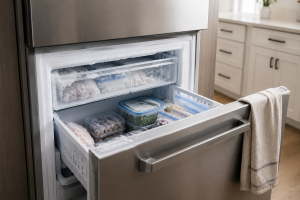
Why a Freezer That Will Not Freeze Needs Fast Attention
A freezer removes heat from a sealed food compartment and releases that heat through the condenser system. When airflow, defrosting, temperature sensing, door sealing, or compressor operation is interrupted, the freezer may still make noise while the food temperature slowly climbs.
The tricky part is that early freezer problems can look normal from the outside. The light may work. The control panel may respond. You may hear a fan or compressor. But if air cannot move across the evaporator coil, if the gasket leaks warm moist air, or if the compressor cannot maintain pressure, the freezer will not hold 0 degrees F consistently.
Food safety matters here. The FDA recommends freezer temperatures of 0 degrees F, and USDA guidance explains that frozen food held at 0 degrees F remains safe, although quality changes over time. If the freezer is warming and you do not know how long food has been above safe temperatures, protect the food first and diagnose the appliance second.
For local help, Universal Appliance Repair can diagnose the appliance safely and explain whether repair is practical before parts are replaced. Start with the related service page when the problem points beyond basic homeowner checks: Freezer repair, Refrigerator repair.
Step-by-Step Troubleshooting
1. Confirm the freezer temperature with a thermometer
Control dials do not always show the real compartment temperature. Place an appliance thermometer between frozen packages and check again after the door has stayed closed. A freezer that cannot return toward 0 degrees F after several hours needs closer attention.
2. Look for a door or lid that is not sealing
A small gap can pull warm, moist air into the cabinet. Check for food packages, baskets, frost, or a twisted gasket keeping the door from closing. Clean sticky gasket surfaces with mild soap and warm water, then dry them fully.
3. Clear blocked vents and crowded shelves
Freezers need air movement. If frozen bags are packed tightly against vents, cold air may short-cycle around one area while another area thaws. Leave space along the back wall and avoid pressing items into fan covers.
4. Check whether heavy frost is covering the evaporator area
A wall of frost can mean the defrost system is not clearing ice from the coil. Manual defrosting may temporarily restore airflow, but recurring frost usually points to a failed heater, sensor, timer, control, fan, or gasket problem.
5. Clean accessible condenser coils
Dust on condenser coils makes it harder for the freezer to reject heat. If your model has accessible coils, unplug the appliance and clean them gently with a coil brush and vacuum. Do not bend tubing or force panels open.
6. Listen for fan and compressor patterns
A healthy freezer often cycles with a steady hum and fan movement. Clicking, buzzing, grinding, or long silent periods with rising temperature are signs to stop guessing and call for freezer repair.
7. Consider recent loading or door-open time
Adding a large amount of unfrozen food, leaving the door open, or storing the freezer in a hot garage can make recovery slower. If the unit was recently loaded, give it time while monitoring temperature. If it never recovers, the load was not the real cause.
8. Check power and outlet conditions safely
Confirm the plug is fully seated and the breaker has not tripped. Do not use extension cords for freezers, and do not keep resetting a breaker that trips again.
9. Move food before diagnosis takes too long
If packages are soft, leaking, or above safe temperature, transfer them to another freezer or cooler with ice. Appliance troubleshooting should never gamble with food safety.
10. Call when cooling does not return
If the freezer is powered, sealed, reasonably loaded, and still not freezing, internal diagnosis is needed. Compressor, sealed-system, fan, sensor, and control issues require testing beyond safe homeowner checks.
Brand-Specific Considerations
Whirlpool and Maytag: Watch for frost patterns, airflow issues, and service diagnostics tied to thermistors, defrost controls, and evaporator fans.
GE and Frigidaire: Many upright and garage-ready models depend heavily on clean coils and correct ambient conditions. Repeated clicking deserves professional testing.
LG and Samsung: Electronic controls, inverter compressors, and sensor-driven cooling can hide failures behind normal display lights. Error codes and fan behavior matter.
Sub-Zero and built-in refrigeration: Integrated units use tighter airflow design and higher-value components. Early diagnosis is better than extended thaw cycles.
Brand design matters because the same symptom can come from different parts depending on the model. A traditional mechanical appliance may fail in a visible, direct way. A newer electronic model may pause, lock out, show a code, or keep the display normal while a sensor or control input prevents normal operation. Keep the model number handy before scheduling service.
Repair vs. Replace Guidance
Repair is usually worth considering when the freezer is under 10 years old, the cabinet and gasket are in good condition, and the issue is a fan, defrost, thermostat, relay, or control failure. Replacement becomes more reasonable when the unit is older, has sealed-system or compressor failure, has rusted cabinet sections, or has repeated food-loss events. For a premium built-in or matching appliance set, repair may still make sense even with a higher estimate.
As a practical rule, compare the repair estimate with the appliance age, part availability, cosmetic condition, and how central the appliance is to the household. A modest repair on a well-kept midlife appliance often makes sense. A major sealed-system, transmission, cabinet, or control repair on an appliance near the end of its expected life deserves a replacement conversation.
Appliance Lifespan Table
Refrigerator: 10-15 years. Maintenance priority: clean coils, protect door seals, and keep temperatures steady.
Freezer: 10-20 years. Maintenance priority: keep vents clear, check gasket contact, and defrost models that require manual defrosting.
Dishwasher: 8-12 years. Maintenance priority: clean the filter, inspect spray arms, and avoid blocked drain paths.
Washing machine: 8-12 years. Maintenance priority: avoid overloading, use the right detergent amount, and inspect hoses.
Dryer: 10-13 years. Maintenance priority: clean the lint filter, vent path, and exterior termination.
Range or oven: 10-15 years. Maintenance priority: keep burners, igniters, caps, racks, and controls clean.
Maintenance Checklist
- Keep the appliance level so doors, baskets, tubs, and burners line up correctly.
- Clean user-accessible filters, vents, gaskets, burner caps, and exterior surfaces on a routine schedule.
- Use the owner manual for cycle settings, loading limits, and cleaning products.
- Take a clear photo of error codes, unusual frost, water marks, flame behavior, or damaged parts before the condition changes.
- Stop using the appliance when there is burning odor, gas odor, repeated breaker tripping, visible wiring damage, flooding, or overheating.
Safety Section
Stop troubleshooting and call for help if you smell gas, notice burning odor, see scorch marks, hear arcing, find melted plastic, feel heat around a cord or outlet, see water near electrical components, or the breaker trips more than once. Do not bypass safety switches, force stuck parts, probe live wiring, remove sealed refrigeration fittings, or keep restarting an appliance that is clicking, overheating, or behaving unpredictably.
If food temperature may be unsafe, protect the food first. If gas may be involved, protect the people first. If electricity may be involved, protect the circuit first. Appliance repair can wait until the immediate risk is controlled.
What to Tell the Technician
Before scheduling service, write down the model number, approximate appliance age, when the symptom started, whether it happens every cycle or only sometimes, and what changed recently. Recent cleaning, moving the appliance, power outages, heavy loads, door-left-open events, spills, remodel work, or new error codes can all shorten diagnosis time.
Also note what you already checked safely. A clear list such as "cleaned gasket, checked breaker once, verified other burners work, tried normal cycle, or measured 48 degrees F inside the refrigerator" is more useful than repeated resets. Good notes help the technician separate a setting issue from a part failure and reduce the chance of replacing parts that are not related to the real cause.
Key Takeaways
- Start with safe, visible checks before assuming the most expensive failure.
- Use temperatures, error codes, sounds, and repeatable symptoms as evidence.
- Do not keep cycling an appliance that clicks, trips a breaker, smells hot, leaks, or behaves differently each time.
- Brand and model design affect diagnosis, especially with electronic controls and sensor-driven appliances.
- A professional diagnosis is worthwhile when the issue involves gas, electricity, sealed cooling, motor drive, or control systems.
Homeowner Actionability Score
8/10. Homeowners can safely check temperature, seals, loading, airflow, visible frost, accessible coils, and power conditions. The score is not higher because refrigerant, compressor, control, and evaporator repairs require professional tools.
Author Information
This article was prepared by the Universal Appliance Repair Certified Expert Team, drawing on field-informed appliance repair experience, manufacturer service guidance, food-safety references where relevant, and Universal Appliance Repair’s residential appliance service standards for Southern California homeowners.
Summary
Primary keyword: freezer not freezing Search intent: Informational to commercial investigation Recommended URL: https://universalappliancerepair.com/freezer-not-freezing-troubleshooting-repair-guide/ Word count: 1895 words before FAQ and structured data.