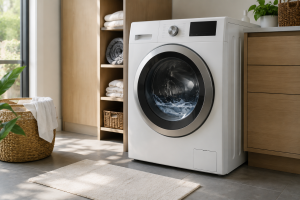
Why Washers Walk, Shake, and Bang
A washer spins fast to pull water out of laundry. During that high-speed spin, weight inside the drum must be distributed evenly. When towels, bedding, rugs, mats, jeans, or waterproof items clump to one side, the drum becomes lopsided. The washer may slow the spin, stop and retry, add water to redistribute the load, display an error code, or shake hard enough to move.
Some movement is normal. A washer has a suspension system because the drum is supposed to move within limits. The problem starts when the whole cabinet rocks, bangs, hops, or slides. A washer that is properly installed on a firm floor should not repeatedly walk across the room.
Installation matters just as much as the load. Front-load washers are shipped with bolts or braces that lock the drum in place during transportation. If those bolts are not removed before the first wash, the drum cannot move as designed, and the machine can vibrate violently. Manufacturer guidance from Whirlpool, LG, GE, and Samsung all points homeowners toward load balance, leveling, shipping bolts, and floor contact as early checks before assuming the machine has failed.
Age matters too. Older washers can develop worn shock absorbers, weak suspension rods, stretched springs, loose counterweights, worn bearings, or tub support problems. When these parts lose control of drum movement, the washer may bang even when the load is reasonable.
Troubleshooting Steps Before You Call
1. Stop the Cycle Safely
If the washer is walking, banging, or moving enough to pull on hoses, pause or stop the cycle from the control panel. Wait for the drum to stop completely before opening the door or lid. Do not grab the cabinet, reach under the washer, or try to hold the machine in place while it is spinning.
If the washer is moving toward a wall, water line, drain line, gas appliance, or electrical outlet, stop using it until the cause is found. A damaged fill hose can turn a vibration problem into water damage.
2. Look at the Load First
Open the washer after the drum stops and check how the laundry is sitting. Heavy items often twist into a ball or stick to one side. Towels, blankets, comforters, small rugs, bath mats, and waterproof covers are common troublemakers.
Redistribute the load loosely around the drum. If the washer is packed full, remove some items. If there is only one bulky item, add a few similar-weight items so the washer can balance the spin. Do not add random lightweight items to one heavy blanket and expect the load to balance.
3. Avoid Overloading the Drum
A full washer is not always an efficient washer. Laundry needs room to tumble and distribute itself. When the drum is packed too tightly, clothes cannot move freely, rinse properly, or balance during spin.
As a practical rule, avoid stuffing laundry past the point where items can move. For bulky loads, choose the correct cycle and load size. If the washer repeatedly shakes with bedding, reduce the load and use the bedding or bulky cycle if your model has one.
4. Check the Floor and Washer Level
Place a bubble level across the top of the washer from side to side and front to back. Then press gently on opposite corners of the washer. If it rocks, the feet are not all firmly contacting the floor.
Adjust the leveling legs only if you can do so safely. The legs should not be extended farther than needed. Long, wobbly legs can make vibration worse. After adjusting, tighten the lock nuts against the washer base so the legs do not drift during future cycles.
5. Confirm Shipping Bolts Were Removed
If the washer is a newer front-load model or was recently moved, check whether the shipping bolts were removed. These bolts hold the drum in place during transport and must be removed before normal use. A drum that feels rigid, has almost no spring movement, or shakes violently from the first cycle may still be locked.
Do not keep running the washer if shipping bolts may still be installed. Operating a front-load washer with the shipping system in place can damage internal suspension parts.
6. Check the Pedestal or Laundry Platform
If your washer sits on a pedestal, confirm the pedestal is secure and all mounting points are tight. A loose pedestal can amplify vibration and make the washer appear worse than it is.
Laundry platforms, drain pans, and soft flooring can also contribute to movement. A washer needs a firm, stable base. If the floor flexes heavily during spin, the machine may keep vibrating even after leveling.
7. Inspect Visible Hoses and Clearances
After a walking event, look behind and around the washer if you can do so safely. Confirm the fill hoses are not stretched, the drain hose has not pulled loose, and the power cord is not pinched. Also check that the washer is not contacting a wall, cabinet, dryer, or shelving during spin.
A washer needs enough clearance to move slightly without hitting nearby surfaces. If it bangs into a dryer or cabinet, the noise may sound like a major internal failure even when the first issue is placement.
8. Check for Standing Water or Drain Trouble
A washer that cannot drain fully may reduce spin speed, repeat balance attempts, or leave clothing wet. If vibration appears along with wet clothes, a long spin, or standing water, the washer may be fighting a drain restriction.
Check the visible drain hose for kinks. If your front-load washer has an accessible pump filter and the manual explains how to clean it, follow the instructions carefully and prepare for water. If the washer is full of water, leaking, or the filter will not open safely, call for service.
9. Run One Empty or Light Test Cycle
After correcting an obvious load or leveling issue, run one manufacturer-approved rinse-and-spin or spin-only test with no load or a small balanced load. Watch from a safe distance.
If the washer runs smoothly empty but shakes with one type of load, the problem may be loading technique, cycle choice, or floor support. If it shakes hard when empty, the issue is more likely installation, suspension, bearing, tub, or internal support related.
10. Stop Testing When the Symptom Repeats
Repeated test cycles can make the problem worse. If the washer walks again after basic corrections, stop. Continuing to run it can loosen hoses, damage the suspension, crack plastic parts, or stress the cabinet.
At that point, professional appliance repair is the better next step.
Brand-Specific Considerations
Whirlpool Washers
Whirlpool guidance commonly points homeowners toward load balance, shipping bolts, leveling, floor stability, pedestal security, and basket or drum issues. If a Whirlpool washer jumps or walks after the load has been corrected and the machine is level, schedule Whirlpool appliance repair before the movement damages surrounding surfaces.
LG Washers
LG front-load and top-load washers may vibrate when shipping bolts remain, laundry is bunched on one side, the washer is not level, or the load size is unsuitable. Many LG models also rely on calibration and balance detection. If an LG washer keeps vibrating after leveling and load correction, professional LG appliance repair can check suspension, sensor, and internal support issues.
GE Washers
GE front-load washer guidance includes unbalanced loads, clogged drain pump filters, shipping bolts, leveling legs, and solid floor support. GE also notes that minor movement can occur in certain out-of-balance situations, but repeated severe walking points toward a problem. If a GE washer vibrates empty or keeps moving with normal loads, GE appliance repair is appropriate.
Samsung Washers
Samsung washers may shake when the legs are not firmly contacting the floor, a large bulky item is inside, too much laundry is loaded, or front-load shipping bolts were not removed. Samsung also notes that some brief vibration can occur during weight sensing. If movement continues beyond normal sensing and load correction, service is recommended.
Top-Load vs. Front-Load Differences
Top-load washers often rely on suspension rods, springs, balance rings, and tub supports. Front-load washers often rely on shock absorbers, springs, counterweights, bearings, and shipping bolt removal. Both styles can shake from an unbalanced load, but the repair path can be different.
Washer Walking vs. Washer Not Spinning
A washer that walks and a washer that will not spin can overlap, but they are not the same problem. A washer may refuse to spin because it detects imbalance. In that case, walking is prevented by the control system, but clothes may remain wet. A washer that does spin but moves across the floor may have a load, leveling, floor, or suspension issue.
Use this simple split: if the drum never reaches spin speed, focus on load balance, drain issues, door or lid lock signals, and no-spin diagnosis. If the drum reaches speed but the cabinet moves, focus on leveling, shipping bolts, floor support, suspension, and internal drum control.
Repair vs. Replace Guidance
Repair is often worth it when the washer is under eight years old, does not leak, has no major rust, and the likely cause is leveling, a pump restriction, shock absorbers, suspension rods, springs, a lock issue, a sensor issue, or a correctable installation problem. These repairs are usually more sensible than replacing an otherwise healthy washer.
Replacement may make more sense when the washer is older than 10 to 12 years, has major tub bearing failure, recurring control issues, cabinet rust, repeated leaks, a damaged outer tub, or repair costs approaching the cost of a new machine. Also consider replacement if the washer has already had several major repairs in a short period.
The most important decision point is whether the washer is otherwise doing its job. A machine that washes well and only needs suspension or leveling work is different from a machine with vibration, poor draining, bearing noise, leaks, and electrical symptoms together.
Appliance Lifespan Guide
Top-load washer: Typical lifespan is 8 to 12 years. Maintenance priority is balanced loading, hose inspection, level feet, and avoiding chronic overloading.
Front-load washer: Typical lifespan is 8 to 12 years. Maintenance priority is shipping bolt removal after installation, gasket care, pump filter cleaning where accessible, and load balance.
Stacked laundry center: Typical lifespan is 10 to 13 years. Maintenance priority is stable installation, correct venting for the dryer, balanced washer loads, and avoiding cabinet movement.
Washer-dryer combo: Typical lifespan is 8 to 12 years. Maintenance priority is filter care, balanced loads, drain maintenance, and avoiding overloading.
Dryer paired with washer: Typical lifespan is 10 to 13 years. Maintenance priority is lint filter cleaning, vent maintenance, and not overloading with excessively wet laundry from a poor washer spin.
Laundry pedestal: Typical service life varies by installation. Maintenance priority is secure mounting, level feet, and checking fasteners after vibration events.
Maintenance Checklist to Prevent Washer Vibration
Load loosely and evenly: Do not pack laundry tightly or let heavy items clump on one side.
Avoid one-item bulky loads: Wash blankets, mats, and towels in balanced groups when the model allows it.
Use the right cycle: Choose bulky, bedding, towel, or heavy-duty cycles when appropriate.
Check level every few months: Floors settle and lock nuts can loosen over time.
Keep all feet on the floor: A washer should not rock diagonally when pushed gently at the corners.
Do not ignore new noises: Grinding, scraping, and repeated banging usually get worse.
Clean accessible pump filters: If your model has a serviceable filter, follow the manual and clean it before clogs become spin problems.
Inspect hoses after movement: A walking washer can stress fill and drain hoses.
Use proper installation after moving: Relevel the washer after relocation and reinstall shipping bolts only for transport, not operation.
Schedule service early: Repeated violent vibration can turn a smaller repair into a bigger one.
Safety Section
A walking washer can create water, electrical, and injury risks. Stop the machine from the control panel if it moves enough to strain hoses or strike nearby surfaces. Wait for the drum to stop before opening the door or lid. Do not hold the washer in place while it spins.
Do not bypass lid locks or door locks. These safety systems prevent access to a moving drum. Do not reach under the washer while it is connected to power. Do not tip or lift a washer alone; washers are heavy and can cause serious injury.
If the washer leaks, trips a breaker, smells hot, sparks, or makes grinding noises, stop using it and arrange service. If a fill hose is stretched or damaged after the washer moves, turn off the water supply valves if you can reach them safely.
When to Schedule Washer Repair
Schedule service if the washer shakes violently after you rebalance the load and level the machine. Also call if the washer walks with ordinary loads, bangs when empty, has a visibly off-center drum, makes metal scraping sounds, leaves clothes wet because spin keeps slowing, displays repeated balance codes, or recently moved enough to pull on hoses.
Universal Appliance Repair services major washer brands across Los Angeles and the San Fernando Valley. If the washer is moving, leaking, or repeatedly failing spin, a trained technician can check installation, suspension, drain performance, internal supports, bearings, and controls without turning a safety issue into guesswork.
Key Takeaways
A washer that walks is usually reacting to imbalance, installation, leveling, floor support, or worn suspension parts.
Start with safe checks: stop the cycle, rebalance the load, reduce bulky items, check the level, and confirm shipping bolts were removed.
Do not keep running a washer that moves repeatedly. Walking can damage hoses, flooring, cabinetry, pedestals, and internal parts.
Grinding, scraping, leaks, hot smells, breaker trips, and empty-cycle vibration are professional repair signals.
Repair is often worthwhile for otherwise healthy washers under eight years old. Replacement becomes more reasonable when vibration is paired with age, rust, bearing failure, leaks, or repeated major repairs.
Homeowner Actionability Score
Score: 8 out of 10. Homeowners can safely resolve many washer walking problems when the cause is load balance, overloading, cycle choice, floor contact, or basic leveling. The score is not 10 because repeated vibration can involve heavy appliance movement, internal suspension parts, electrical systems, water connections, bearings, or drain components that should be diagnosed by a professional.
Final Editorial QA Checklist
Search intent matched: Yes. The article answers urgent homeowner questions about a washer walking, shaking, banging, and moving during spin.
SEO/AEO/GEO optimized: Yes. The article uses the primary keyword naturally, answers the quick question early, includes symptom-based headings, supports conversational search, and references Los Angeles and San Fernando Valley service relevance.
E-E-A-T signals included: Yes. Safety guidance, professional repair triggers, manufacturer-informed brand considerations, repair-versus-replace context, and visible author information are included.
No Markdown tables: Confirmed. All comparison content uses bold-labeled text blocks for WordPress readability.
FAQ body rule followed: Yes. FAQ content is provided below for dedicated WordPress FAQ fields only and should not be pasted into the blog body.
Internal links checked: Planned body links target live UAR service and brand pages.
External references checked: Whirlpool, LG, GE, and Samsung support references were reviewed for manufacturer-specific vibration guidance.
Author placement: Author information is the last paragraph of the blog body before the dedicated FAQ section.
Author Information
Written by: Universal Appliance Repair Editorial Team.
Reviewed for homeowner accuracy by: Universal Appliance Repair service professionals. Universal Appliance Repair helps Los Angeles and San Fernando Valley homeowners diagnose and repair washer, dryer, refrigerator, freezer, dishwasher, oven, range, microwave, ice maker, and range hood problems.